← Back to catalog
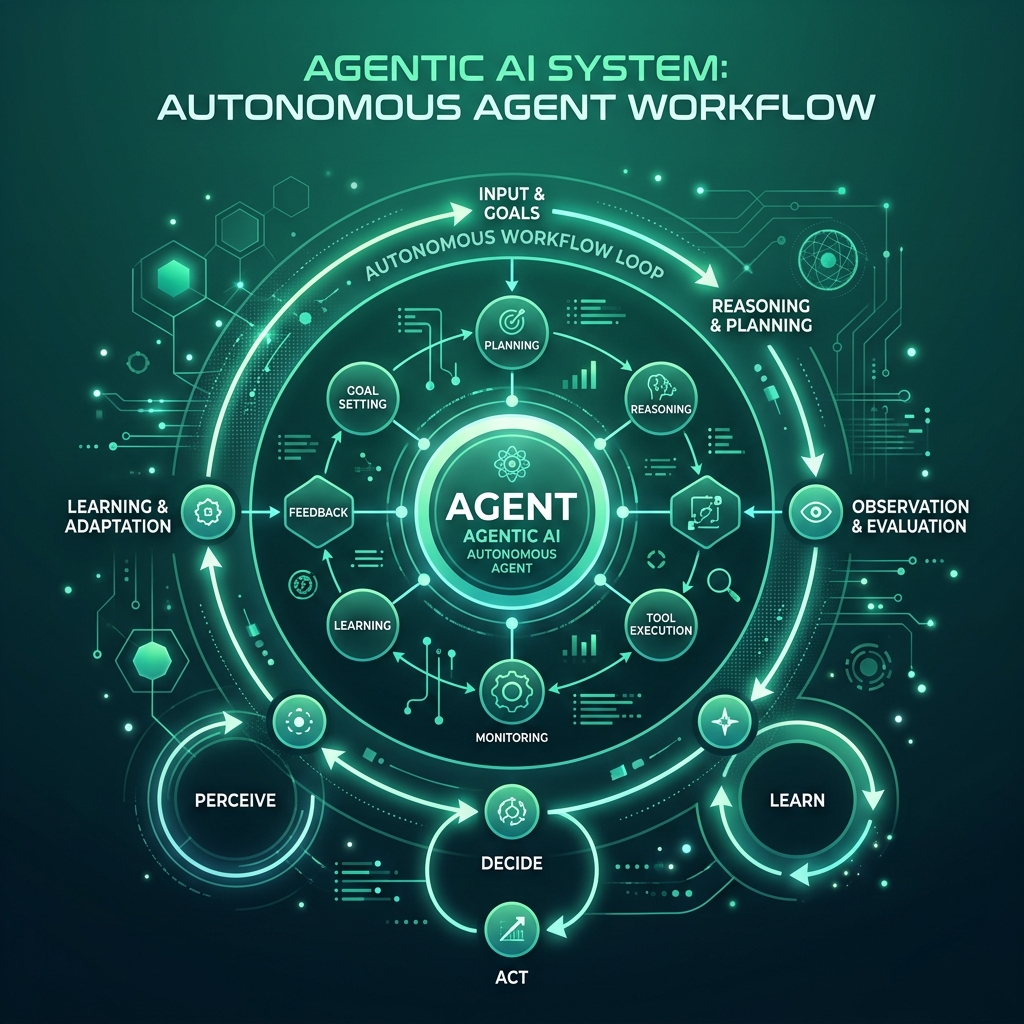
Introduction to Agentic AI cover image
Agentic AI Beginner ★ Featured

Introduction to Agentic AI

Learn how goal-driven AI systems plan, call tools, and verify results.

Instructor Maya Iyer
Duration 75 minutes (6 lessons)
Estimated Effort 2.5 hours total (1.5 hrs/week over 2 weeks)
Price Free
100% Free Full Lifetime Access

Sign in to track your learning progress.

Sign in to start Start exploring

Course Overview

Build a practical mental model for agent loops, tool boundaries, and reliable task completion. You will leave with small patterns for evaluating agent behavior without treating every prompt as magic.

What You Will Learn

Architect single-agent loops with goal decomposition and state tracking
Define explicit tool interfaces with schema validation and error recovery
Implement deterministic fallback logic when agent tool execution fails
Measure agent task completion reliability using structured log telemetry
Establish safe execution boundaries for automated system actions

Tools & Technologies Used

Python 3.11 LangGraph Pydantic FastAPI Qdrant

Structured Curriculum

2 Modules  ·  6 Lessons  ·  75 Minutes Total

Module 1

Module 1: Foundations of Goal-Driven AI

3 lessons

Deconstruct agentic architecture, control loops, and state machine models.

  • 📄

    Agent vs. Simple Completion Models

    Compare deterministic linear prompts against iterative ReAct agent cycles.

    Interactive Lecture 15 min
  • 📄

    Designing State Schema & Tool Boundaries

    Model bounded state containers using Pydantic and explicit type annotations.

    Code Walkthrough 20 min
  • 📄

    Building Your First Reasoning Loop

    Implement a 3-step decision loop with exit criteria and iteration limits.

    Hands-on Exercise 20 min
Module 2

Module 2: Tool Integration & Safety Guardrails

3 lessons

Connect external functions while enforcing parameter contracts and safety boundaries.

  • 📄

    Defining Strict Tool Schemas

    Register search and database retrieval functions with strict runtime typing.

    Hands-on Exercise 20 min
  • 📄

    Handling Tool Execution Exceptions

    Gracefully handle API timeouts, missing data, and invalid arguments without crashing the loop.

    Lab Session 25 min
  • 📄

    Evaluating Agent Decision Drift

    Audit decision traces to detect hallucinated parameters and ungrounded tool calls.

    Case Study 15 min

Practical Project & Capstone Outcome

🚀 Capstone Project

Autonomous Customer Support Triaging Agent

Build an agent that receives incoming customer tickets, queries a mock knowledge base using validated tools, categorizes issue severity, and produces a verified response draft.

Prerequisites

  • Basic proficiency in Python (functions, dictionaries, type hints)
  • Understanding of REST APIs and JSON structure

Intended Audience

  • Backend Engineers seeking to build reliable LLM-powered services
  • AI Engineers moving beyond basic prompt wrappers to stateful agents
  • Technical Product Managers evaluating agentic automation feasibility

Instructor Information

M

Maya Iyer

Course Author & Industry Expert

Maya Iyer is a Principal AI Systems Architect with over a decade of experience building enterprise automation pipelines. She previously led agentic infrastructure teams at CloudScale AI.

Frequently Asked Questions

Do I need access to paid LLM API keys to complete this course?

No. The course includes mock client adapters compatible with local testing and standard Mesh endpoint configurations.

How is this course different from prompt engineering guides?

This course focuses on software engineering patterns—state management, tool schemas, and error boundaries—rather than prompt tuning tricks.

Can I apply these patterns to non-OpenAI model providers?

Yes! All architectural patterns taught are model-agnostic and rely on standard JSON schemas.